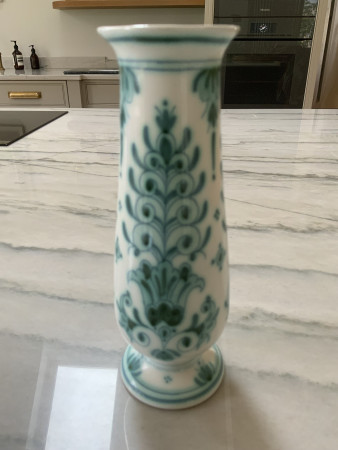
How old is it? Is it called delft? It has two very small chips in the rim - can they be repaired.?
Afmetingen
20cm x 7.5cm approximately
Collectie
publiekscollectie
Reacties 2
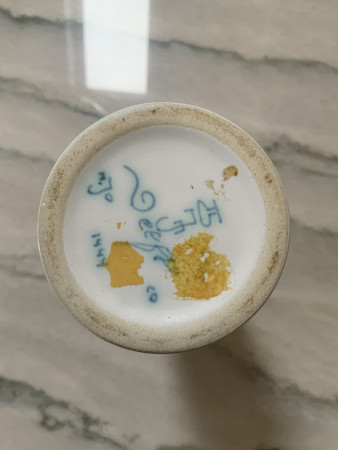
This is painted by Mrs. Jongsma in 1970 for "de Porceleyne Fles" from Delft.
This is a piece from the Delvert collection (also known as "Green Delft").
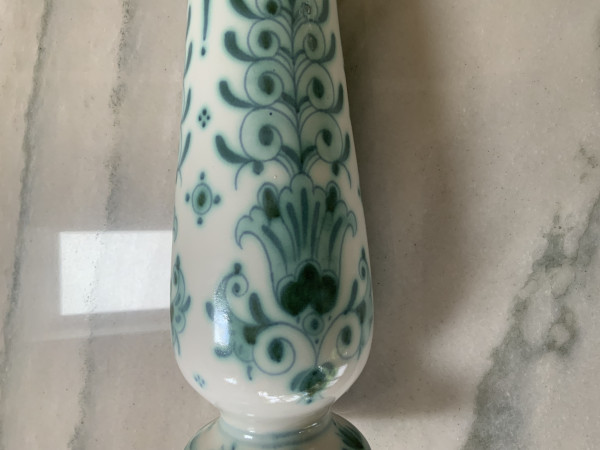
The Color (Delvert): Unlike standard Delft Blue, you can recognize this series by the characteristic blue-green (turquoise) color. This line was introduced in 1967, based on designs by Herman Sanders.
The production of this series proved to be technically very difficult because the green color was often unstable during firing. Therefore, production was already discontinued in 1976. There was a brief reintroduction in the 1990s, but that also stopped quickly. This makes Delvert pieces rarer than traditional blue.
Although the motifs (such as the stylized peacock tail-like leaves on your vase) are based on classical forms, they have a much more modern look due to the color and the cleaner lines, which is typical of the 1960s and '70s
kind regards Franky
Verdict:
Delftware
Analysis:
Delftware, but made after 1850
After 1850, the earthenware production technique changed at the only remaining pottery in Delft. This technique goes beyond the scope of this website.
Read more
Hand-painted
An important characteristic of authentic Delftware is that it is hand-painted. Printing techniques do not occur on this earthenware.
Read more
Mark of a Delft pottery/factory
In the 19th century, a financial incentive arose to sell more new earthenware as antique Delftware, sometimes even bearing fake Delft factory marks.
Read more
Add new comment
Only logged in users can post comments Log in or register to post comments










Reacties 2
This is painted by Mrs. Jongsma in 1970 for "de Porceleyne Fles" from Delft.
This is a piece from the Delvert collection (also known as "Green Delft").
The Color (Delvert): Unlike standard Delft Blue, you can recognize this series by the characteristic blue-green (turquoise) color. This line was introduced in 1967, based on designs by Herman Sanders.
The production of this series proved to be technically very difficult because the green color was often unstable during firing. Therefore, production was already discontinued in 1976. There was a brief reintroduction in the 1990s, but that also stopped quickly. This makes Delvert pieces rarer than traditional blue.
Although the motifs (such as the stylized peacock tail-like leaves on your vase) are based on classical forms, they have a much more modern look due to the color and the cleaner lines, which is typical of the 1960s and '70s
kind regards Franky
Verdict:
Analysis:
Add new comment
Only logged in users can post comments
Log in or register to post comments