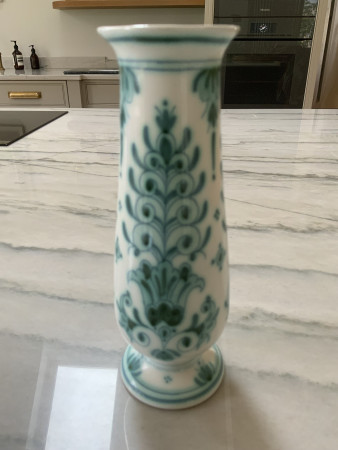
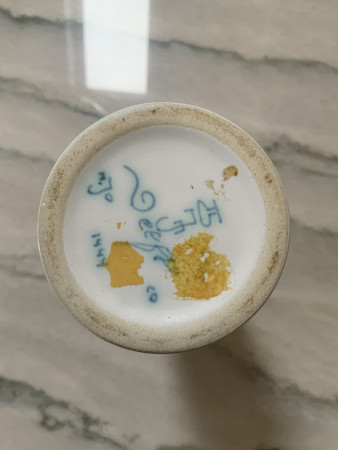
How old is it? Is it called delft? It has two very small chips in the rim - can they be repaired.?
Afmetingen
20cm x 7.5cm approximately
Collectie
publiekscollectie
Reacties 2
This is painted by Mrs. Jongsma in 1970 for "de Porceleyne Fles" from Delft.
This is a piece from the Delvert collection (also known as "Green Delft").
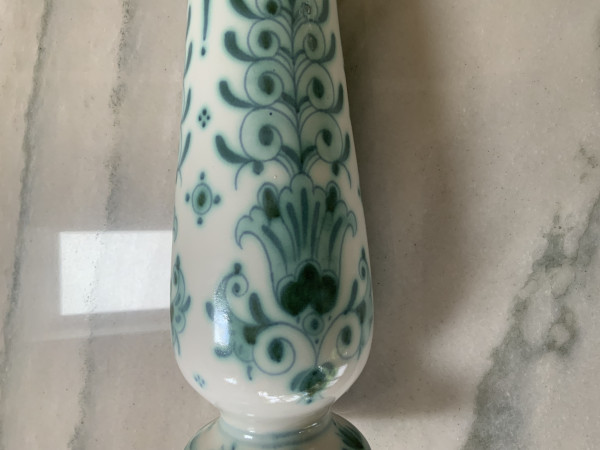
The Color (Delvert): Unlike standard Delft Blue, you can recognize this series by the characteristic blue-green (turquoise) color. This line was introduced in 1967, based on designs by Herman Sanders.
The production of this series proved to be technically very difficult because the green color was often unstable during firing. Therefore, production was already discontinued in 1976. There was a brief reintroduction in the 1990s, but that also stopped quickly. This makes Delvert pieces rarer than traditional blue.
Although the motifs (such as the stylized peacock tail-like leaves on your vase) are based on classical forms, they have a much more modern look due to the color and the cleaner lines, which is typical of the 1960s and '70s
kind regards Franky
Beoordeling:
Delfts
Toelichting:
Delfts, maar na 1850 gemaakt
Na 1850 verandert de productietechniek voor aardewerk bij de enige overgebleven plateelfabriek in Delft. Dit valt buiten de scope van deze website.
Lees meer
Handbeschilderd
Een belangrijk kenmerk van authentiek Delfts aardewerk is dat het handgeschilderd is. Druktechnieken komen op dit aardewerk niet voor.
Lees meer
Merk van Delftse plateelbakkerij/fabriek
Dankzij historisch onderzoek weten we steeds meer over de merken die Delftse plateelbakkerijen gebruikten. Benieuwd naar deze bakkerijen?
Lees meer
Reactie toevoegen
Alleen ingelogde gebruikers kunnen reacties plaatsen Login of registreer om te reageren










Reacties 2
This is painted by Mrs. Jongsma in 1970 for "de Porceleyne Fles" from Delft.
This is a piece from the Delvert collection (also known as "Green Delft").
The Color (Delvert): Unlike standard Delft Blue, you can recognize this series by the characteristic blue-green (turquoise) color. This line was introduced in 1967, based on designs by Herman Sanders.
The production of this series proved to be technically very difficult because the green color was often unstable during firing. Therefore, production was already discontinued in 1976. There was a brief reintroduction in the 1990s, but that also stopped quickly. This makes Delvert pieces rarer than traditional blue.
Although the motifs (such as the stylized peacock tail-like leaves on your vase) are based on classical forms, they have a much more modern look due to the color and the cleaner lines, which is typical of the 1960s and '70s
kind regards Franky
Beoordeling:
Toelichting:
Reactie toevoegen
Alleen ingelogde gebruikers kunnen reacties plaatsen
Login of registreer om te reageren