
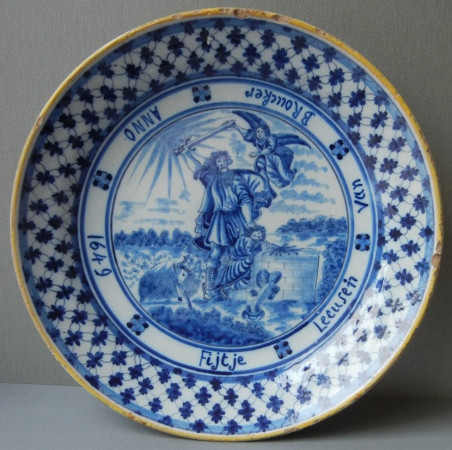
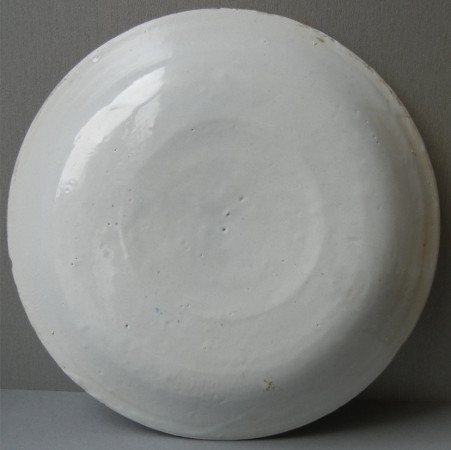
A dated blue and white Delft dish, border decorated with a trellis-pattern band and a small Yellow line rim, the center depicting in medaillon ‘The Sacrifice of Abraham’ (Aqedah or Binding of Isaac) and surrounded between 2 pairs of concentric circles the commemorative text:
‘. Fijtje . Leeusen . Van . B Roucker . ANNO . 1649 .’,
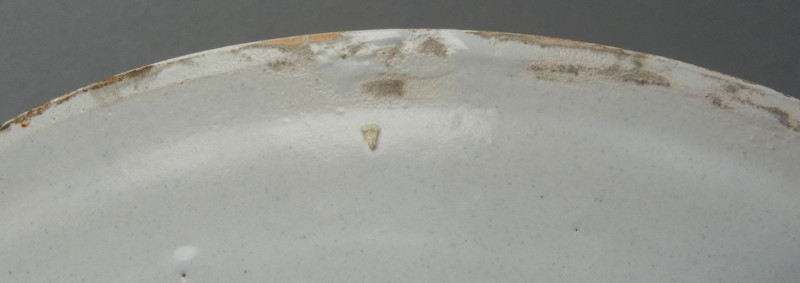
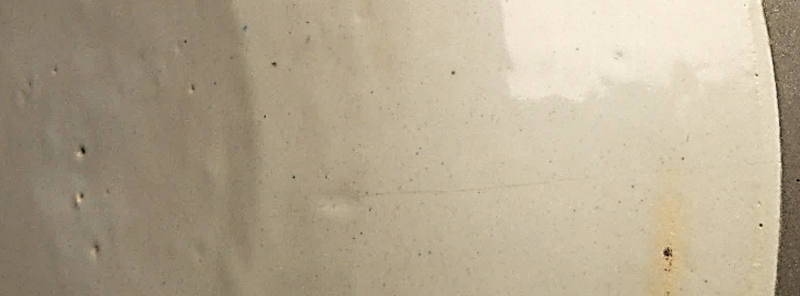
Delft, Unmarked, Ca. mid 17th century T.B.D*., D. 23,3cm – h. 3cm with three tiny stilt marks on the back, Consolidated very faint hairline (photo: contrast enhanced and color manipulated to make the hairline visible), Small chipping to the border, no restoration, UV checked.
Fake or Real?
For comparision see:
https://am.adlibhosting.com/ais6v2/Details/museum/6414
The Washington Winter Show of January 8–10, 2016: (Both dishes have a Diameter of approx 31-32cm)
https://antiquesandthearts.com/the-washington-winter-showtradition-and-…
&
https://www.antiquesandthearts.com/wp-content/uploads/2016/01/Washingto…
https://www.rijksmuseum.nl/nl/collectie/object/---9b50a1672744bb9d4662d…












Reacties 15
Unfortunately Fake. Origin ?
Kind regards,
Als antwoord op Unfortunately Fake. Origin ?… door R.L.A. Maes982
Dear R.L.A. Maes (sorry ✌️) , thx for your quick answer and I do respect your opinion., I feel also there is something to the dish, but I’m not able to put my finger on it (the wound) .
For the readers: (I forgot, my apology)
*TBD: “Te Be Determined.” (For age and origin Delft-Amsterdam-Rotterdam-Haarlem or France, whether it is a original, a 18/19th c. copy or a fake, etc.)
1. The reasons why I put the dish on the site is :
a) I’m not shure if it is a fake or not (see certainly TBD* above and point 2 and 3 below), because it is really a unusual dish and maybe worth preserving iwith the propper accurate labeling.
b) The hairline is NOT consolidated but it safes me some money if it is a fake.
c) Fakes I allways destroy, there is no going back.
Are you really for 100% shure and certain this is a Fake???
2. I was not able to find other examples of “pancake” dishes with a yellow border, nor or in combination with that particular trellis-pattern.
3. Other observations are:
a) the sharp drawinglines for example of Abraham’s clothes and the sheep’s horns.
b) the point on the letter ‘n’.
c) the yellow line over (up on) the white tin-glazed-border (a majolica technique). see below.
d) the calligraphy is different and seems modern when compared with the other dishes given in the links above.
4) At the moment for me, including the points mentioned above, I am not certain any of it is conclusive or proven. So R.L.A. Maes the question you are waiting for (knowing you, you have allready prepared one 😊): On what do you base your conclusion that this dish is a fake? Please elaborate and include controllable references, etc.
5) Depending on your answer, I will ask 3 known and trusted expert sources their independent opinion about this dish. If they are all three of the same opinion, it will be destroyed.
With kind regards, Jeff
Number and text is not a 17th-century writing style, regards jvdh.
Getal en tekst is geen 17e eeuwse schrijfwijze, groet jvdh.
Dear Jan, Thx for your opinion, indeed I saw that too as mentioned in point "3d" above, but my observation was written in the context that Delft decorators did use different writing-styles on 17th century faience depending what the cliënts and their budget asked of them to produce; the show pieces (eg. the Haarlem plates), the adapted show pieces or the more common ones etc., therefor it can not be used as a criteria to determine the age, see for example:
https://delftsaardewerk.nl/dadd/28460
https://delftsaardewerk.nl/dadd/15114
https://www.rm-auctions.com/auctions/european-ceramics-and-decorative-a…
https://www.endlich.nl/app/uploads/2019/01/TEFAF-2018-catalogus-john-en…
https://commons.wikimedia.org/wiki/File:Inktstel_met_de_wapens_van_Leid…
I have other arguments concerning the dish, but non are conclusive to determine the age or the origin, instead they produce more questions.
I wrote the auctioneer, maybe he knows something about the story of the dish via the former owner, I'm waiting for his answer, it might help.
Thx for the help and with kind regards, Jeff
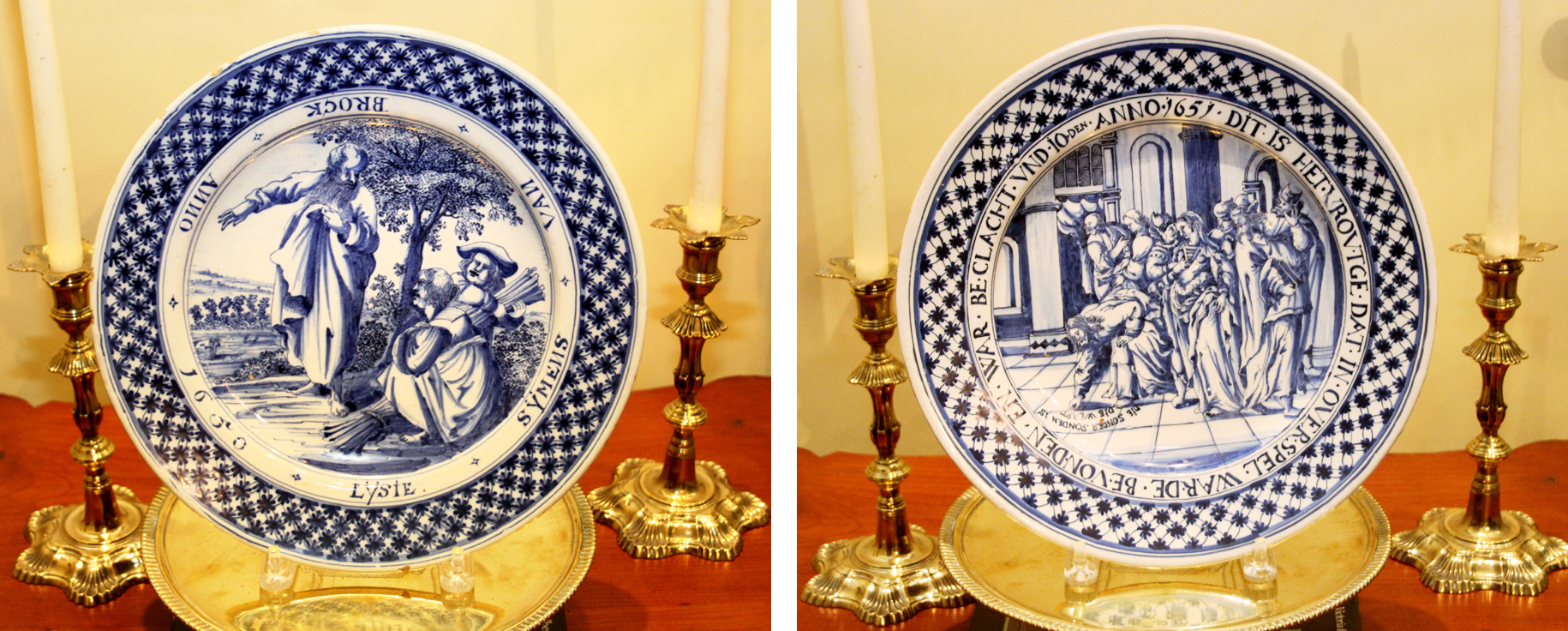
Hello, 100000% FAKE, Recently on on German auction.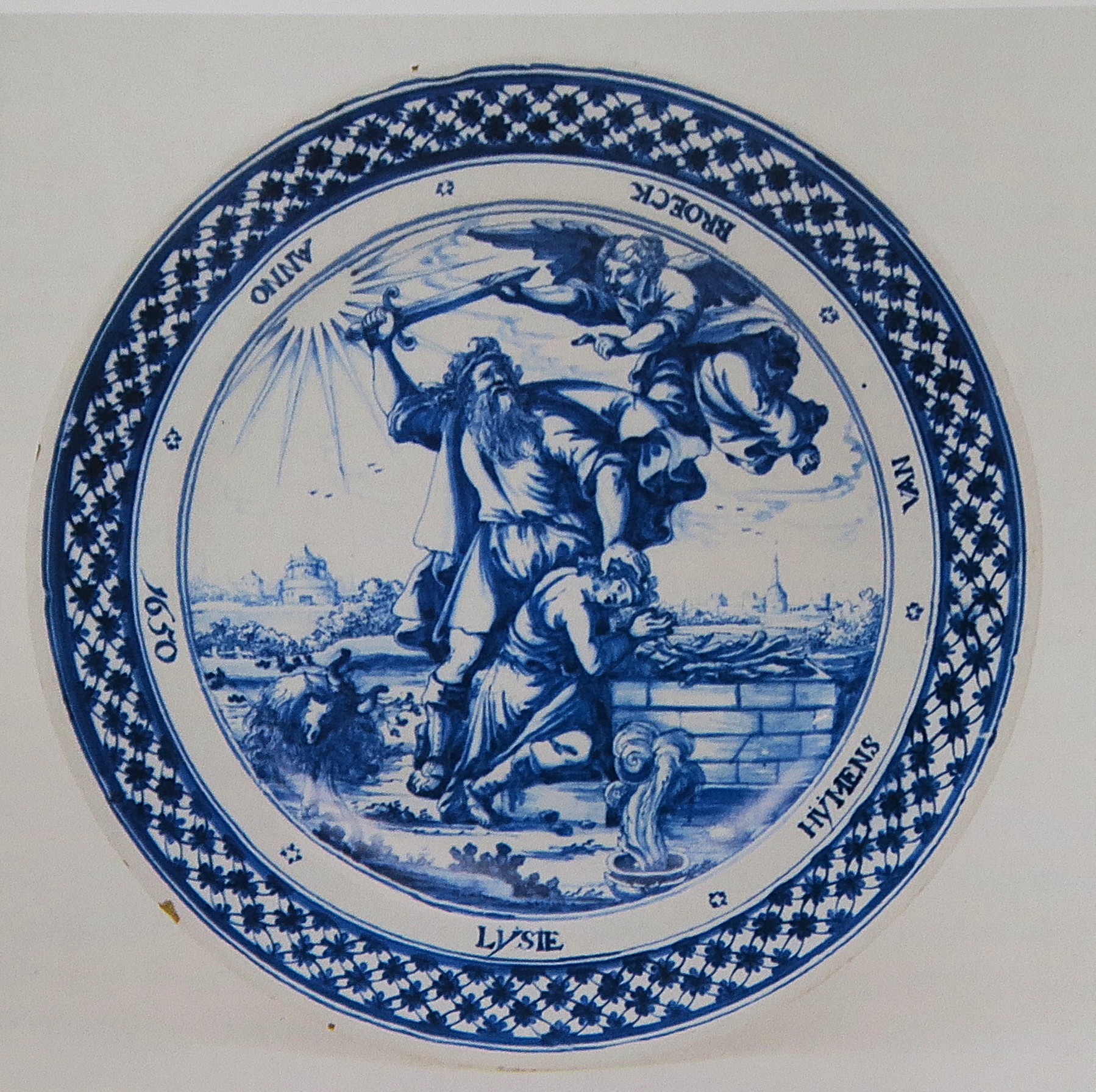
See, the photo of the original.
Als antwoord op See, the photo of the… door Edwin van Drecht193
Thx Edwin, very convincing, Where did you find it, Book , title? Internetsource? Where is it, private or museum collection?
I was not able to find it. Please let me know.
Grts, Jeff
Als antwoord op Thx Edwin, very convincing,… door Jeff
Hello Jeff, The ORIGINAL Haarlem charger you can find in the Wadsworth Atheneum Museum of Art, Hartford Ct.
Credit Line:
The Richard and Georgette A. Koopman Collection of Delft
Object ID:
2004.26.13
Als antwoord op Hello Jeff, The ORIGINAL… door Edwin van Drecht193
Dear Edwin,
Thx for sharing the information, my compliments! It is very helpfull!!!
If by any chance you know of other dishes with the same trellis-pattern decoration, can you place the link here?
Many Thx,
Jeff
Als antwoord op Dear Edwin, Thx for sharing… door Jeff
Hello Jeff, My apologize for the delay, here another 2 with that Trellis border. Regards, Edwin van Drecht.
Als antwoord op Hello Jeff, My apologize for… door Edwin van Drecht193
Hello Edwin, thank you very much for the pictures, can you by any chance give the internet link ? There might be more info about the two latest dishes you were so kind to share photo's of.
For the people who would like the link of the first dish Edwin kindly shared see:
https://5058.sydneyplus.com/argus/final/Portal/Public.aspx?lang=en-US&p…
Then klik on search and type "delft".
Looking forward for your answer Edwin,
Kind regards,
Jeff
Als antwoord op Hello Edwin, thank you very… door Jeff
Dear Jeff, Unfortunately I do not have an Internet link. These 2 sensational and very rare dishes belonged to the collection of Benjamin F. Edwards, St.Louis Missouri. He died in 2009. Part of the collection was sold via Christie's NY. but these 2 dishes were sold via his good friend, the antique dealer Mark Allen. Mark Allen sold these 2 dishes to a private collector from Texas in July 2019. With kind regards, Edwin van Drecht. Ps. Ben Edwards got these 2 dishes from Aronson Antique dealers/Amsterdam
Dear Jeff,
Unfortunately feelings or opinions are not what makes something real or fake.
I think we have all made one wrong buy in our life. I sure did. Luckily, just a very small monetary loss.
Here is another nice example in Het Rijksmuseum Amsterdam:
https://delftsaardewerk.nl/dadd/28229
So, I will put some points here:
1. This particular colour blue used here was never ever used in Delft in the 18th and most certainly not in the 17th century.
2. The paintwork itself is not of high quality when compared to the other examples provided. It also use very strange forms of TREK (black outlines).
3. The yellow rim is a feature that came into fashion and use only somewhere around or after 1725. It was to copy porcelain that sometimes had a brown or yellow rim. This is known in de 18th century as “de gebruyneerde rande”.
It is without any doubt whatsoever a replica from the end of the nineteenth century. Maybe Northern France, maybe south Germany.
If you want to contact other antiquairs or curators, please do but prepare yourself to be disappointed.
Jeroen
Reactie toevoegen
Alleen ingelogde gebruikers kunnen reacties plaatsen
Login of registreer om te reageren